
Lead Generation & Google Business Profile SEO Services
Soureep SEO Services helps businesses generate qualified leads, improve Google visibility, and build a stronger online presence. Our SEO strategies are designed for local businesses, startups, service providers, and growing brands across India.
Lead Generation Services
We provide targeted lead generation solutions based on your industry, audience, and business goals:
B2B Lead Generation – Connect with decision-makers and potential business clients.
B2C Lead Generation – Reach consumers actively searching for your products or services.
Local Lead Generation – Generate enquiries from customers in specific cities and service areas.
Inbound Lead Generation – Attract prospects through SEO, content, and search marketing.
PPC Lead Generation – Capture high-intent customers through paid search campaigns.
SEO Lead Generation – Increase organic traffic and convert relevant searches into enquiries.
Social Media Lead Generation – Use platforms such as Facebook, Instagram, LinkedIn, and YouTube to reach potential customers.
Qualified Lead Generation – Focus on prospects that match your target customer profile.
Exclusive Lead Generation – Generate enquiries intended specifically for your business.
Outsourced Lead Generation – Let an experienced marketing team manage your lead acquisition process.
Industries We Serve
Our lead generation and SEO strategies can be customised for a wide range of industries, including:
Accountants, builders, plumbers, electricians, roofers, cleaning companies, dentists, estate agents, financial advisers, mortgage brokers, law firms, solicitors, home improvement companies, landscapers, solar installers, security companies, surveyors, removal companies, and other local service businesses.
Each campaign focuses on relevant keywords, local search visibility, conversion-focused landing pages, and measurable marketing performance.
Google Business Profile SEO
Google Business Profile, formerly known as Google My Business, is an important part of local SEO. A well-optimised profile can help your business appear in Google Search and Google Maps when customers search for relevant products or services.
How to Improve Google Maps Rankings
Key areas of Google Business Profile optimization include:
Accurate business name, address, and phone information
Correct primary and secondary business categories
Detailed business description
Updated opening hours
Relevant products and services
High-quality business photos
Genuine customer reviews
Regular Google Business Profile updates
Consistent local citations
A strong, relevant business website
Local keyword optimisation
Performance and ranking monitoring
Avoid fake reviews, misleading business information, artificial clicks, or other manipulative tactics. Sustainable local SEO should focus on relevance, trust, accurate information, and genuine customer engagement.
SEO and Effective Marketing Frequency
Customers often need multiple interactions with a brand before they become ready to enquire or purchase. This is why businesses should maintain consistent visibility across search engines, social media, content, video, and other relevant marketing channels.
A strong strategy can combine:
SEO
Google Ads/PPC
Google Maps
Content marketing
Social media
Video marketing
Email marketing
Remarketing
Local SEO
Digital PR and genuine link building
The goal is to keep your brand visible throughout the customer journey and turn that visibility into qualified traffic, enquiries, and sales.
Why Choose Soureep SEO Services?
At Soureep SEO Services, we focus on practical SEO and lead generation strategies that help businesses improve online visibility and attract potential customers.
Whether you need SEO services, local SEO, Google Maps optimisation, lead generation, or digital marketing, our approach is built around your business goals, target audience, location, and competition.
Ready to generate more leads and improve your Google rankings? Contact Soureep SEO Services today.
12 Types of SEO
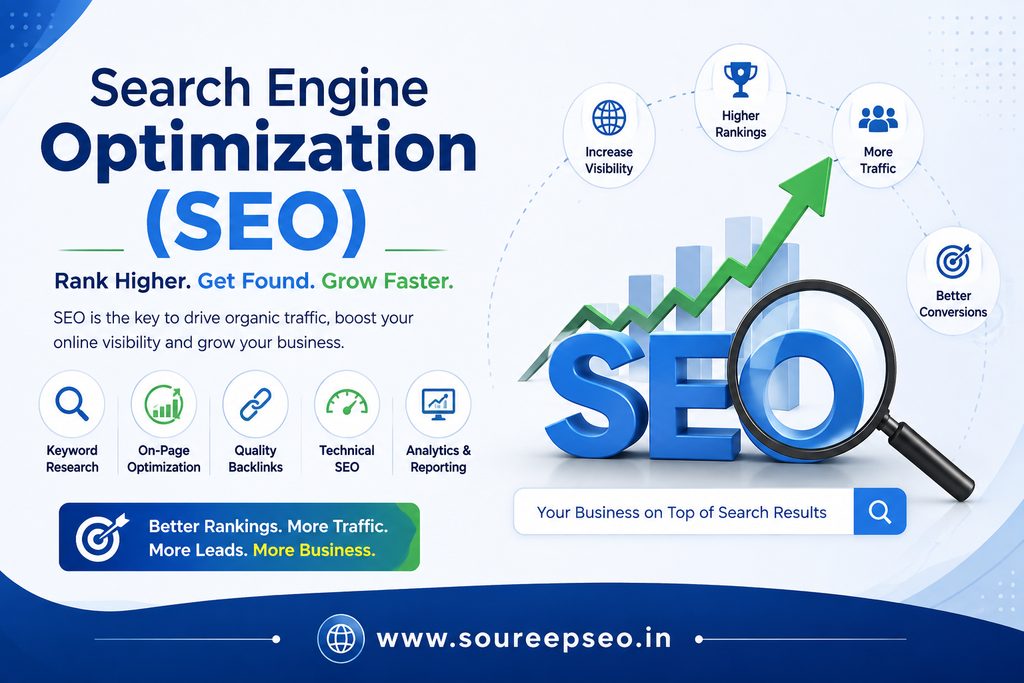
SEO (Search Engine Optimization) is the process of improving a website’s visibility in search engine results and attracting relevant organic traffic. Different SEO techniques focus on content, technical performance, authority, location, and search intent.
On-Page SEO
On-page SEO optimizes elements within a website to improve rankings and user experience. It includes:
Internal linking
Title tags and meta descriptions
Image optimization
SEO-friendly URLs
Off-Page SEO
Off-page SEO improves a website’s authority through activities outside the site, such as:
Guest posting
Digital PR
Competitor research
Brand mentions
Social promotion
Technical SEO
Technical SEO helps search engines crawl, index, and understand a website. Key areas include:
Website speed
Mobile-friendliness
Crawl errors
Duplicate content
Keyword cannibalization
Site structure
International SEO
International SEO helps websites reach audiences in different countries and languages. It focuses on localized content, currencies, languages, and regional search preferences.
Local SEO
Local SEO helps businesses appear in local search results and Google Maps. It is especially useful for businesses targeting customers in specific cities or regions.
E-commerce SEO
E-commerce SEO improves the visibility of online stores and product pages in search results. It focuses on product optimization, site architecture, categories, and relevant keywords.
Content SEO
Content SEO focuses on creating useful, relevant, and optimized content that satisfies search intent. It combines keyword strategy, copywriting, site structure, and regular content updates.
Mobile SEO
Mobile SEO ensures that websites perform well on smartphones and tablets. It focuses on responsive design, easy navigation, page speed, and mobile usability.
White-Hat SEO
White-hat SEO uses ethical strategies that follow search engine guidelines. Examples include creating helpful content, optimizing metadata, and improving website usability.
Black-Hat SEO
Black-hat SEO uses manipulative tactics designed to artificially improve rankings, such as keyword stuffing, cloaking, and spammy link building. These techniques can lead to search engine penalties.
Gray-Hat SEO
Gray-hat SEO involves techniques that fall between commonly accepted practices and clearly prohibited tactics. Because guidelines can be unclear, these methods carry greater risk than white-hat SEO.
Negative SEO
Negative SEO involves unethical attempts to harm another website’s rankings, such as generating spammy backlinks or publishing malicious content. It is generally considered harmful and unethical.
SEO vs GEO vs AEO: What’s the Difference?
Search is evolving beyond traditional Google rankings. SEO, GEO, and AEO work together to improve visibility across search engines, AI platforms, and answer engines.
What is SEO?
SEO (Search Engine Optimization) is the process of improving a website’s visibility in search engine results pages (SERPs) and attracting organic traffic.
The three main SEO pillars are:
Technical SEO: Improves site speed, mobile usability, crawlability, and indexability.
On-Page SEO: Optimizes keywords, headings, titles, meta descriptions, content, and page structure.
Off-Page SEO: Builds authority through quality backlinks, brand mentions, and external signals.
Goal: Rank higher in search results and attract organic clicks.
What is GEO?
GEO (Generative Engine Optimization) focuses on improving how AI platforms such as ChatGPT, Google Gemini, and Perplexity understand, mention, and cite your brand or content.
Key GEO strategies include:
Build clear and consistent brand entities.
Publish accurate, authoritative content.
Develop topical authority.
Use original insights and first-party data.
Organize content with clear sections and internal links.
Support claims with credible sources and expert opinions.
Goal: Increase your chances of being mentioned or cited in AI-generated answers.
What is AEO?
AEO (Answer Engine Optimization) focuses on creating content that directly answers users’ questions in search engines and AI-powered answer platforms.
Effective AEO strategies include:
Create FAQ and Q&A sections.
Provide concise, direct answers.
Use headings, lists, tables, and other structured formats.
Optimize content around search intent and questions.
Add relevant schema markup to help search engines understand your content.
Goal: Become a trusted source for featured snippets, AI Overviews, voice search, and direct answers.
SEO vs GEO vs AEO
| Strategy | Main Focus | Primary Goal |
|---|---|---|
| SEO | Search rankings | Get organic clicks |
| GEO | Generative AI | Get mentioned and cited by AI |
| AEO | Direct answers | Become the answer users see |
What Is Query Fan-Out?
Query fan-out breaks a broad query into smaller validation questions.
For example, a search for “Best SEO consultant In Kolkata” may require checks around:
Who the consultant is
What services they provide
Their experience and expertise
Reviews and reputation
Recent results and activity
Independent mentions
Positive and negative feedback
This means SEO content should answer the main query and its related questions, not just repeat a target keyword.
The 6 Main Query Fan-Out Dimensions
| Dimension | What It Checks |
|---|---|
| Entity | Who or what the query refers to |
| Attribute | Services, features, pricing, capabilities |
| Reputation | Reviews, authority, trust and recognition |
| Freshness | Whether information is current |
| Consensus | Whether multiple sources agree |
| Contradiction | Complaints, risks and conflicting information |
Entity
Make it clear who you are, what you do, where you operate, and what makes your business identifiable.
Attribute
Clearly explain your services, features, industries, locations, pricing models, processes and capabilities.
Reputation
Build genuine trust through reviews, testimonials, case studies, awards, expert mentions and independent references.
Freshness
Keep important information updated, especially services, pricing, achievements, business activity and recent case studies.
Consensus
Create consistent information across your website and reputable third-party platforms. Independent sources agreeing on the same facts can strengthen credibility.
Contradiction
Don’t ignore negative information. Address legitimate FAQs, limitations, complaints, risks and common objections clearly and honestly.
Does Query Fan-Out Differ by Search Intent?
Yes. Informational searches may focus more on entities and attributes, while commercial and recommendation searches can require stronger checks around reputation, consensus and contradictions.
The deeper the uncertainty or risk, the more validation may be required.
How to Optimize Content for Query Fan-Out
To make content easier for AI systems to understand and retrieve:
Answer the primary question immediately.
Cover closely related long-tail questions.
Use clear H2 and H3 headings.
Create concise, self-contained sections.
Define entities and services clearly.
Include factual evidence where available.
Add genuine reviews and third-party references.
Keep important information current.
Address pros, cons and limitations.
Use consistent business information across platforms.
Build topical authority instead of keyword stuffing.
Why Passage-Level Content Matters
AI systems can retrieve individual passages or content chunks rather than relying only on an entire webpage.
A concise section that directly answers a specific question is therefore easier to understand, retrieve and potentially cite.
Query Fan-Out and SEO
SEO is increasingly moving beyond ranking for a single keyword. Businesses should build content that answers the complete information journey behind a search.
The goal is to create a trusted content ecosystem covering:
Entity → Attributes → Reputation → Freshness → Consensus → Contradiction
The more clearly your website answers relevant questions with accurate, useful and trustworthy information, the better positioned your content can be for AI search, Google AI features, featured snippets and traditional organic search.
CONTACT US