
AI SEO Statistics: How AI Search Is Changing SEO in 2026
AI-powered search is changing how people discover information online. Google AI Overviews, ChatGPT, Gemini, Perplexity, Claude, and other AI platforms are increasingly answering queries directly, reducing the need for users to click traditional search results.
For SEO professionals and businesses, this means tracking AI search visibility, organic traffic, zero-click searches, and AI referrals alongside traditional rankings.
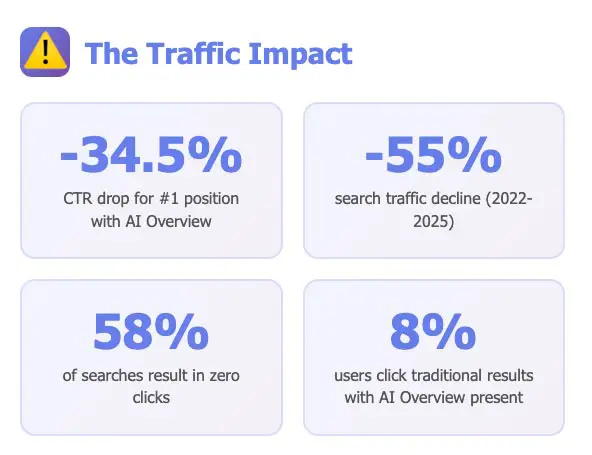
Key AI SEO Statistics for 2026
- AI platforms account for 6.24% of website sessions, up from 0.11% in Q1 2023.
- Organic search traffic fell 23.6% across the research panel between January 2023 and July 2026.
- 74.6% of tracked searches ended without a click in 2026.
- AI Overviews increased the zero-click rate from 62.7% to 82.4%.
- Organic clicks per 1,000 impressions fell by 58.6% when an AI Overview appeared.
- ChatGPT generates 68.4% of AI referral traffic in the 2026 dataset.
- ChatGPT visitors converted to leads at 4.7%, compared with 1.9% for Google organic traffic.
- B2B SaaS receives 11.8% of sessions from AI platforms, the highest among the industries studied.
- Informational searches experienced a 43.9% decline in organic sessions and had a 91.7% zero-click rate.
These figures are based on an analysis of 218 client websites, 12 industries, and more than 3.4 billion sessions from January 2023 through July 2026.
AI Search Is Taking a Larger Share of Website Traffic
AI referral traffic has grown rapidly. It increased from just 0.11% of sessions in Q1 2023 to 6.24% in Q2 2026.
At the same time, organic search’s share declined from 51.3% to 42.8%. AI platforms have therefore become a meaningful traffic source rather than a minor experimental channel.
AI Overviews Are Reducing Organic Clicks
Google AI Overviews can answer a user’s query before they reach traditional organic listings.
When an AI Overview appeared:
- Average organic CTR dropped from 8.7% to 3.6%.
- Organic clicks per 1,000 impressions fell from 87 to 36.
- Zero-click searches increased from 62.7% to 82.4%.
- Average session duration increased by 23%.
- Visitor-to-lead conversion increased from 1.7% to 2.6%.
This shows an important shift: AI search may reduce traffic volume while improving the quality of some visitors who still click through.
Zero-Click Searches Are Growing
Zero-click search is becoming one of the biggest challenges for traditional SEO.
The percentage of searches ending without a website click increased from:
- 54.1% in 2022
- 57.3% in 2023
- 62.8% in 2024
- 69.4% in 2025
- 74.6% in 2026
AI-generated answers, featured snippets, knowledge panels, and other SERP features allow users to find information without visiting a website.
Which Search Queries Are Most Affected?
Informational searches are experiencing the greatest AI disruption.
| Search Intent | Organic Session Change | Zero-Click Rate |
|---|---|---|
| Informational | -43.9% | 91.7% |
| Navigational | -19.4% | 76.3% |
| Commercial | -14.2% | 58.1% |
| Transactional | -5.7% | 37.2% |
The data suggests that searches with stronger commercial or transactional intent are currently more likely to result in a website visit.
AI Search Traffic Can Be Highly Valuable
AI referrals may generate fewer visitors than traditional search, but those visitors can be more engaged.
In the 2026 dataset, AI platforms generated higher visitor-to-lead rates than Google organic search:
- ChatGPT: 4.7%
- Perplexity: 4.1%
- Claude: 3.9%
- Gemini: 2.8%
- Copilot: 2.4%
- Google organic: 1.9%
ChatGPT also accounted for 68.4% of AI referral traffic.
What This Means for SEO
Traditional SEO is still important, but rankings alone are no longer enough. Businesses should optimise for both search engines and AI-powered answer engines.
A modern SEO strategy should focus on:
- Creating original, authoritative content
- Answering search queries clearly and directly
- Demonstrating experience and expertise
- Using structured data and relevant schema markup
- Building strong author and brand credibility
- Targeting conversational and long-tail queries
- Monitoring AI citations and brand mentions
- Optimising content for Google AI Overviews and AI search platforms
- Tracking conversions, not just organic traffic
This approach is often referred to as Generative Engine Optimization (GEO).
SEO and GEO: The Future of Search
The search landscape is moving from ranking for keywords toward being selected as a trusted source for answers.
Your content needs to be easy for both users and AI systems to understand, extract, reference, and trust. That means combining traditional SEO with clear content structures, strong expertise signals, technical optimisation, and GEO.
Final Thoughts
AI search is not eliminating SEO—it is changing what successful SEO looks like.
As AI Overviews and AI assistants continue to grow, businesses should measure organic rankings, AI visibility, citations, referral traffic, engagement, and conversions together.
The goal is no longer simply to rank #1. The goal is to become the source AI search engines choose to reference.